Context
meaning.love
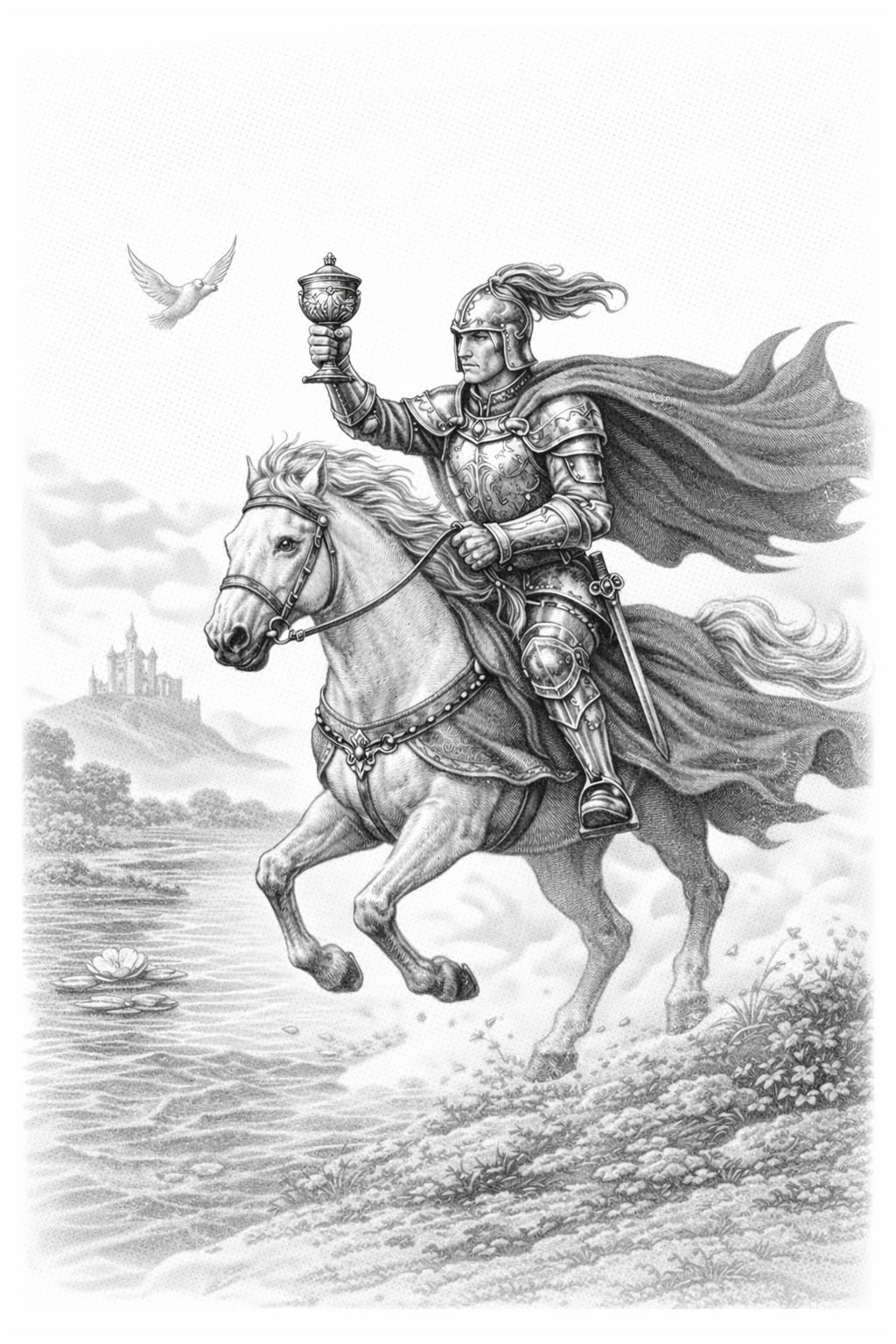
The Knight of Cups in a love context describes the movement of feeling and the arrival of romantic attention. It often represents a person or energy that is poetic, sensitive, and driven by emotion and imagination; someone who approaches relationships with charm, expressive affection, and a desire to create romance. As a state of mind it points to openness, idealism, and an inclination to follow the heart, to compose gestures, offers, and invitations that communicate care.
Interpretively, the card highlights the language of feeling more than practical foundations. It can signify courtship, declarations, creative expressions of love, or an emotional proposition that seeks an aesthetic or soulful connection. At the same time the Knight of Cups can bring moodiness, inconsistency, or a tendency to prioritize fantasy over long-term stability. Sincerity should be observed alongside flourish: poetic words and melodious actions may or may not be matched by steady follow-through.
When using this card analytically, consider whether the emotional approach is balanced by reliability and mutual boundaries. Ask whether the attraction is rooted in a realistic appraisal of compatibility or in an appealing ideal. Useful interpretive angles include examining communication of needs, the presence of mutual reciprocity, and the gap between intention and sustained behavior. In practice, the Knight of Cups encourages openness to emotional expression while advising discernment: welcome tenderness and creativity, but look for consistent care and clear agreements that translate romantic impulses into dependable partnership.
meaning.job
The Knight of Cups in a career context represents the movement of ideas and emotions into the professional sphere: someone who operates from inspiration, charm and persuasive communication rather than from strict pragmatism. This figure is associated with creative proposals, client-facing roles that require empathy and storytelling, or a phase in which work is guided by values, aesthetic sense or a pursuit of meaning. Opportunities may arrive that appeal to personal passions or present themselves as invitations to collaborate or to take on a project that feels personally significant.
Analytically, the card calls attention to the need to translate enthusiasm into structure. Strengths include imaginative problem-solving, diplomacy, and the ability to motivate others through vision. Potential pitfalls are inconsistency, over-romanticizing prospects, or avoiding necessary administrative detail. In a professional setting the Knight of Cups encourages assessing offers not only for how they feel but for their concrete terms: clarify expectations, timelines and responsibilities; document agreements; and pair creative momentum with reliable follow-through.
As a behavioral cue, it points to an emotionally intelligent approach to colleagues and clients—valuing listening, rapport and narrative—while reminding professionals to balance sensitivity with boundaries and practical planning. In evaluation of career choices, the card highlights alignment with personal values and the importance of converting inspiration into actionable steps.
meaning.finance
In a financial context, the Knight of Cups describes an approach to money and opportunities that is driven by ideas, aesthetic sense and emotional engagement rather than by purely pragmatic calculation. It commonly represents offers, proposals or projects that arrive with enthusiasm and charm: creative commissions, partnership invitations, client interest in design- or service-oriented work, or funding tied to artistic, humanitarian or lifestyle values. The energy is forward-moving and exploratory, favoring inspiration, flexible arrangements and relationship-based transactions.
As an analytical signal, the Knight of Cups highlights strengths and potential pitfalls. Strengths include the ability to attract support through charisma and clear vision, to innovate revenue streams through creativity, and to pursue work that aligns with personal values—factors that can increase motivation and long-term satisfaction. Pitfalls include uneven cash flow, deals that are appealing but vague, emotional attachment to ideas that need firmer financial vetting, and a tendency to prioritize the promise of a project over its realistic returns.
For practical evaluation, assess the concrete terms behind appealing proposals: timelines, payment schedules, contingency plans and measurable milestones. Translate inspired concepts into budgets and cash-flow projections, document agreements, and maintain professional boundaries when relationships and money overlap. Where applicable, combine the Knight’s imaginative drive with conservative financial controls to convert creative momentum into stable, measurable outcomes.
meaning.family
The Knight of Cups in a family context describes the presence of emotional energy that is expressive, idealistic, and often artistic. This figure tends to bring offers, invitations and conversations that are framed by feeling and imagination rather than by practicality. In a household this can show up as a family member who gently pursues connection, arranges romantic or sentimental gestures, initiates heartfelt apologies or proposals for change, or introduces creative projects that shift the emotional tone of the home.
Functionally, the card highlights communication driven by empathy and aesthetics: stories, music, poetry or shared rituals may become a way the family negotiates closeness. It also points to sensitivity; emotions are likely to be strongly felt and openly communicated, which can deepen bonds if received with care but can create confusion if messages are inconsistent or overly idealized. The Knight’s tendency toward enthusiasm and movement means intentions are often sincere, but follow-through may be uneven—plans can be romanticized without fully accounting for logistics or long-term responsibility.
For practical use, attend to both feeling and structure. Validate emotional expressions while also clarifying commitments and boundaries. Encourage creative outlets as a means of connecting, and check whether proposals for change include concrete steps to be sustainable. Recognize when idealism is enriching family life and when it obscures necessary everyday tasks. Approached with balance, the Knight of Cups can catalyze deeper emotional honesty and imaginative solutions within the family, provided sensitivity is coupled with realistic attention to how actions affect others.
meaning.mind
As a psychological state, the Cup Knight describes a person whose inner life is led by feeling, imagination, and a search for meaningful emotional experiences. There is an openness to sensitivity and a readiness to pursue what feels aesthetically or romantically significant; feelings are vivid and often expressed with charm or lyrical intensity. Motivations are guided more by desire, empathy, and idealism than by calculation, so decisions can be inspired by intuition, longing, or creative impulse rather than practical considerations.
This state brings strengths such as emotional receptivity, creativity, capacity for empathy, and a willingness to explore possibilities in relationships and inner life. It can increase receptiveness to beauty, symbolic thinking, and artistic or spiritual pursuits. At the same time, the Cup Knight psychological stance can include tendencies toward moodiness, escapism, or disappointment when reality does not match an inner ideal. There may be a pattern of pursuing emotional experiences without fully testing their sustainability, or of shifting attention according to changing feelings.
From a psychological perspective, working with this state involves recognizing when feelings are informative and when they override other necessary considerations. Reflective practices that honor emotion—art, journaling, therapy—help translate rich inner material into integrated understanding. Grounding activities and clear communication can counteract impulsive emotional reactivity and reduce the risk of repeated disappointment. Overall, the Cup Knight signals an active emotional life that benefits from mindful awareness, balanced expression, and a tempering of romantic ideals with clear-eyed appraisal.
meaning.soul
In the context of a person's emotional state, the Knight of Cups represents an orientation toward feeling, imagination, and the pursuit of emotional or aesthetic ideals. It describes someone who is open to emotion, responsive to beauty and sentiment, and inclined to follow impressions and attractions. This state is characterized by receptivity, romanticism, and a readiness to offer or receive emotional overtures; feelings are part of the motivational core rather than background noise.
At the same time, the Knight of Cups points to a degree of volatility and subjectivity. Emotions may be intense but changeable, moving from enthusiasm to wistfulness as impressions shift. There can be a tendency to interpret experiences through a poetic or symbolic lens, which enhances creativity and empathy but can also lead to idealization or projection. The person in this state may prefer gestures, invitations, or symbolic acts over direct confrontation, and may avoid pragmatic or conflict-driven approaches to emotional matters.
From an analytical perspective, this card highlights the interplay between inspiration and realism. It encourages attention to how feelings drive behavior and to the line between genuine emotional insight and emotionally driven fantasy. Observing patterns—how quickly moods arise or fade, whether attraction is based on substance or projection, and how vulnerability is managed—can be useful. In short, the Knight of Cups describes an emotionally engaged, imaginative stance that carries both creative warmth and a need for grounding and clear communication.