Context
meaning.love
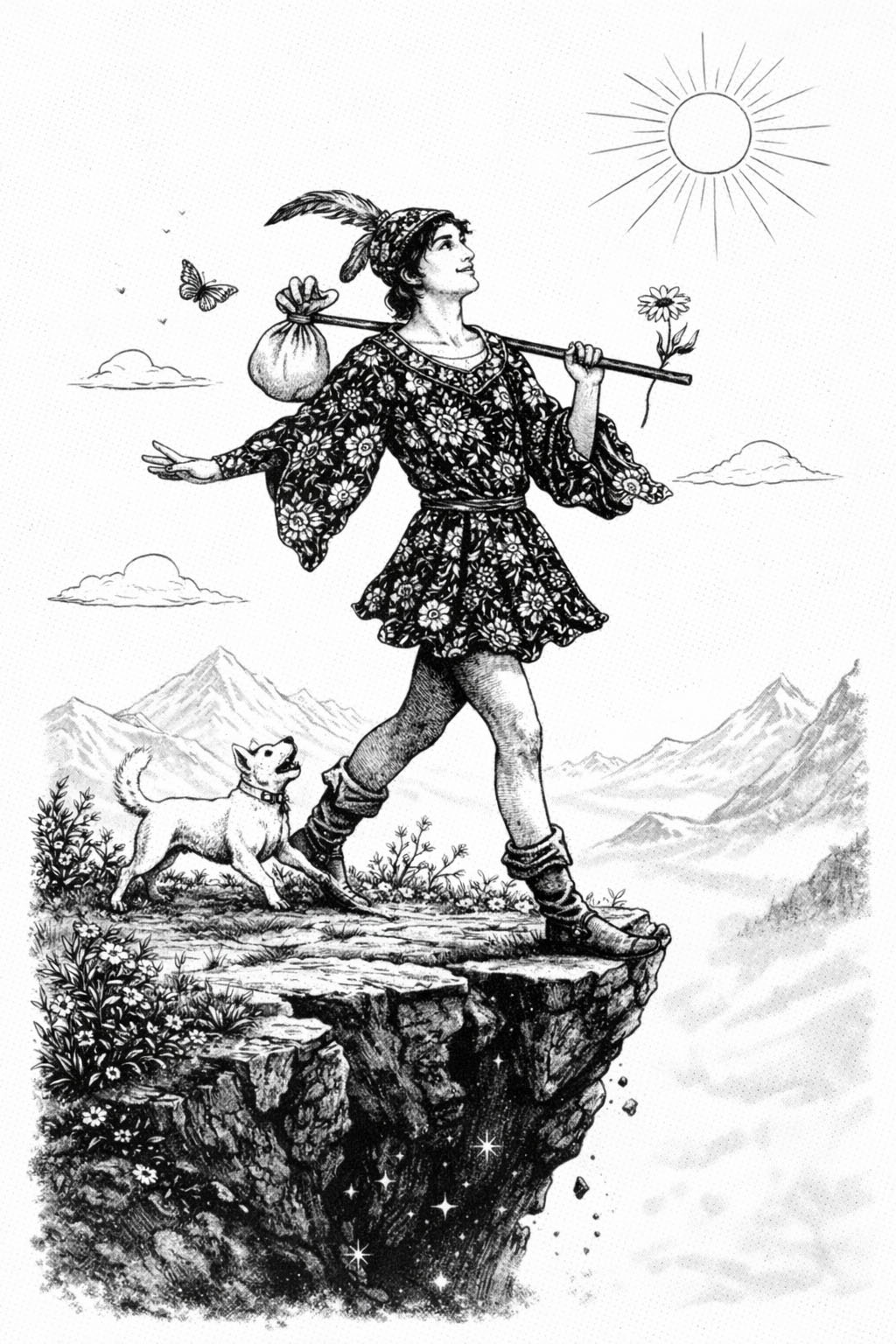
The Fool in a love context highlights themes of beginnings, openness, and a willingness to take emotional risks. It often points to an attitude of curiosity and spontaneity—approaching attraction without heavy expectations, bringing playfulness and a readiness to explore what is possible. For someone single, the card can indicate a phase of experimenting, meeting people without rigid criteria, or rediscovering what draws them to others. In an existing relationship it may describe a period of renewal, lightness, or a deliberate choice to loosen control and rediscover shared joy.
At the same time The Fool carries an instructive tension between innocence and responsibility. The same openness that invites fresh possibilities can also leave a person vulnerable to misunderstanding or oversight of important boundaries. Interpreting the card in an educational way involves examining whether spontaneity is balanced by clear communication and mutual consent, and whether curiosity is guided by awareness of one’s needs and limits. The card encourages learning through experience rather than relying on certainty, but it also invites reflection on patterns—are new beginnings an authentic step forward or a way of avoiding deeper issues?
Seen analytically, The Fool in love describes a phase or stance rather than an outcome: it emphasizes potential, the practice of presence, and the importance of combining wonder with discernment.
meaning.job
The Fool in a career context highlights themes of beginnings, openness to novelty, and a willingness to step into unknown territory. It represents a phase when conventional expectations are less important than curiosity and experimentation: starting a new role, exploring a different industry, launching an independent project, or taking an unconventional path. The card points to fresh perspectives, creative impulses, and a readiness to take risks that can generate growth but also expose gaps in experience or planning.
Interpreting this card analytically involves balancing potential with prudence. The Fool’s energy favors learning through action, improvisation, and adaptable thinking; at the same time it signals the importance of awareness about practical details—contracts, timelines, financial buffers, and realistic skill alignment. In professional development this may translate to pursuing internships, pilot projects, short-term contracts, or entrepreneurial experiments while maintaining mechanisms for feedback and course correction.
For assessment and decision-making, treat The Fool as an indicator to map unknowns and test assumptions before large commitments. Pair enthusiasm with incremental validation: identify what can be learned quickly, what resources are needed, and where mentorship or collaboration could mitigate avoidable risks. Viewed this way, the card is less about predicting success or failure and more about framing a stage of exploratory action that benefits from both imaginative openness and measured preparation.
meaning.finance
In a financial context, The Fool represents beginnings, experimentation, and a readiness to embrace new possibilities. It points to situations where optimism, spontaneity, and a willingness to take calculated risks open doors to novel income streams, ventures, or budgeting approaches. The card highlights advantages of a fresh perspective and low attachment to conventional methods, which can foster innovation and entry into markets or roles with minimal initial overhead.
At the same time, The Fool underlines potential vulnerabilities: limited experience, overlooked details, and a tendency to act on impulse can expose one to avoidable losses or contractual pitfalls. Interpreting this card analytically involves weighing openness against safeguards. It suggests conducting basic due diligence, breaking experiments into small, low-cost trials, clarifying legal and tax implications, and seeking input from more experienced sources when complexity increases. Viewed as a process, The Fool emphasizes learning through practical engagement while balancing adventurous initiative with prudent preparation.
meaning.family
In the context of family life, The Fool highlights themes of beginning, openness, and the willingness to accept change. It can indicate a household atmosphere that favors spontaneity, a lighthearted approach to everyday challenges, and an openness to new roles or relationships. This card often points to a period when curiosity and a lack of preconceived notions allow family members to explore different ways of relating, to try new routines, or to welcome someone new into the family circle.
At the same time, The Fool carries a dual edge: enthusiasm and freedom coexist with naivety and a tendency to overlook consequences. Within a family, this can appear as joyful risk-taking or as insufficient planning around responsibilities. It may reveal a need to balance play and exploration with attention to safety, commitments, and the practical needs of others. It can also reflect the emergence of independence in one member, prompting adjustments in boundaries and expectations.
As an interpretive lens, The Fool encourages observing both the creative potential and the vulnerabilities present in family dynamics. Noting where curiosity and openness are constructive, and where more structure or communication would prevent misunderstandings, makes the card useful for educational reflection about how the family navigates change, responsibility, and personal growth.
meaning.mind
As a description of psychological state, the Fool represents an orientation toward novelty, openness, and an unstructured readiness to engage with experience. It points to a mindset characterized by curiosity, spontaneity, and a willingness to leave familiar patterns behind. In this mode cognitive and emotional filters are loosened: assumptions may be suspended, goals are not yet fixed, and the person is more oriented to exploration and possibility than to consequence mapping or caution.
The card also highlights vulnerabilities inherent in that openness. Naivety, impulsivity, and poor risk assessment can accompany the mindset, as can avoidance of responsibility or a tendency to dissociate from difficult emotions by reframing everything as adventure. Interpersonally, such a state can invite fresh connections but also expose someone to exploitation or unintended harm when boundaries are weak.
From an applied psychological perspective, the image encourages balancing the strengths of openness with grounding strategies. Mindful awareness, reality-testing, incremental decision-making, and attention to safety and boundaries support creative exploration while reducing avoidant or reckless tendencies. When the Fool pattern is persistent and disruptive, reflective practices or professional support can help integrate spontaneity with resilience and practical planning, allowing novelty to coexist with emotional and relational stability.
meaning.soul
When The Fool appears as a description of someone's inner state, it points to an attitude of openness and readiness rather than a fixed outcome. This state is characterized by curiosity, a willingness to experiment, and a sense of freedom from prior constraints; ideas and possibilities feel fresh and unshaped. Psychologically, it represents the moment before commitment, when one senses potential and is guided more by intuition and appetite for experience than by detailed planning.
At the same time, The Fool’s innocence carries ambivalence. The same qualities that enable creativity and bold beginnings—trust, spontaneity, disregard for convention—can also manifest as naivety, impulsivity, and insufficient attention to consequences. From a developmental perspective, this state may reflect a transitional phase: stepping into new roles, testing limits, or engaging in play that is important for learning but not yet integrated into mature routines.
Working with this state of mind benefits from balancing openness with simple structures of attention. Practices that foster awareness of risk, clarify priorities, and invite slow reflection can help preserve the generative aspects of The Fool while mitigating recklessness. Noting impulses, setting small experiments, and reflecting on outcomes support turning exploratory energy into sustainable growth without prematurely closing off options.
Viewed analytically, The Fool as a mood signals both a resource and a challenge: it is the psychological posture that starts journeys, initiates creativity, and resists stasis, but it also requires later grounding and learning to translate adventurous impulses into considered action.