Context
meaning.love
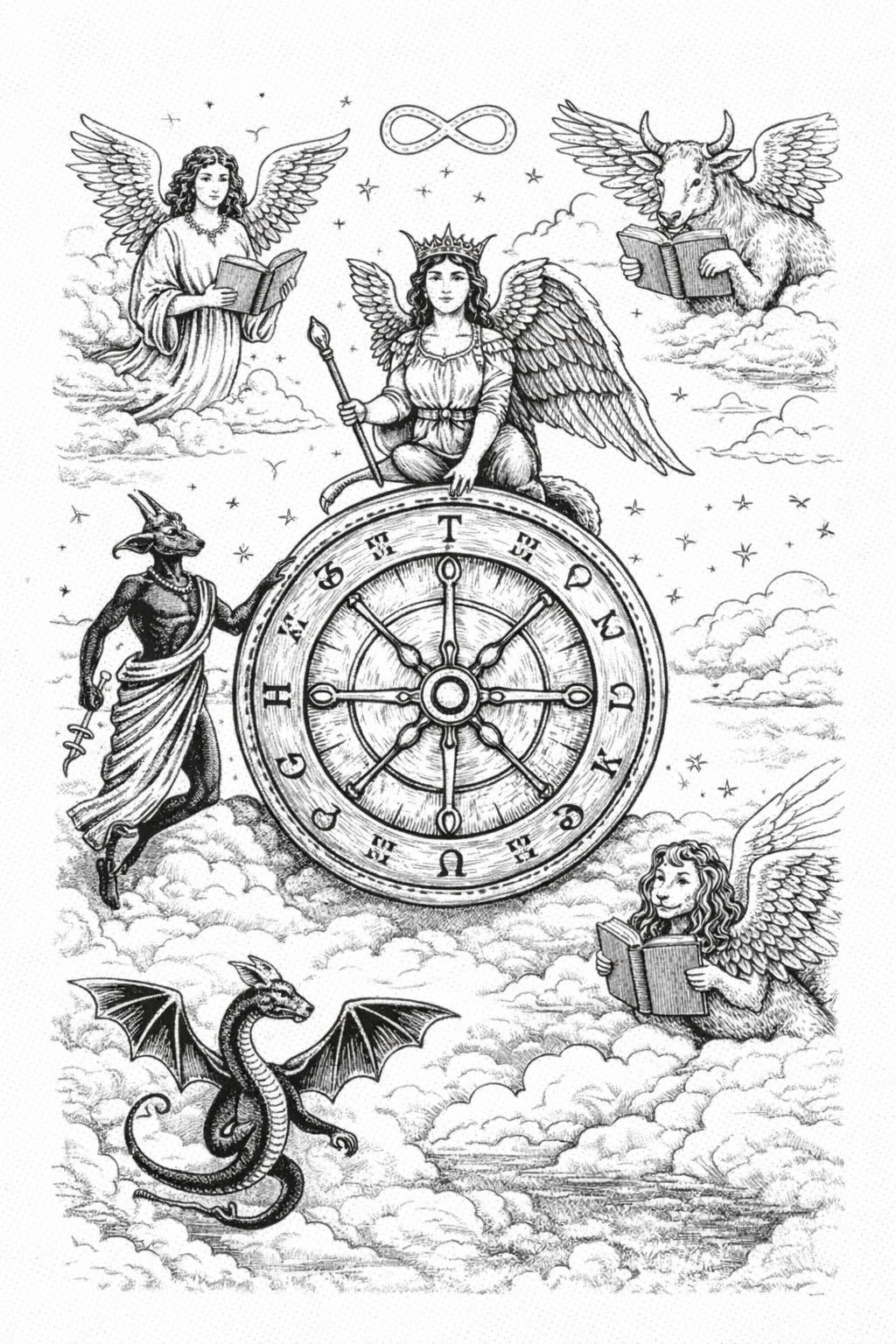
In the context of love, the Wheel of Fortune symbolizes movement, shifting circumstances, and the influence of larger cycles on relationships. It does not prescribe a single outcome but points to times when dynamics are in flux — beginnings, endings, or transitions that alter the pattern of interaction between partners. This card draws attention to the interplay between chance and timing: events outside one’s immediate control, such as changes in life circumstances, encounters that occur through unlikely channels, or the natural ebb and flow of attraction and commitment. It also highlights recurring patterns and karmic threads, prompting consideration of how past choices and habits shape present relational conditions.
Interpreting the Wheel of Fortune in a reading involves balancing recognition of external factors with attention to personal agency. Rather than suggesting that everything is decided by fate, it invites analysis of how one responds to change: adaptability, awareness of repeating cycles, and willingness to break unhelpful patterns. Useful lines of inquiry include identifying any cyclical behaviors in the relationship, examining how timing and context have affected development, and considering whether openness to new possibilities could alter the trajectory. The card encourages a perspective that monitors patterns over time, learns from history, and integrates both acceptance of uncontrollable shifts and deliberate choices that influence future turns.
meaning.job
The Wheel of Fortune applied to a career situation emphasizes movement, change, and the influence of larger cycles beyond an individual’s immediate control. It signals a point at which external conditions—market trends, organizational shifts, industry cycles, or chance events—can alter the shape of a professional path. The card highlights the contingency of circumstances: periods of momentum may give way to slowdowns, and seemingly stable positions can be disrupted by factors unrelated to personal performance.
Analytically, the card invites attention to timing and pattern recognition. Career progress is framed as cyclic rather than linear; past rises and falls may reveal rhythms that are repeating at a different scale. This perspective encourages examination of when to capitalize on favorable conditions and when to conserve resources or reposition for the next phase. It also draws focus to systems and structures—company policies, economic forces, professional networks—that steer opportunities and constraints.
The Wheel of Fortune also embodies the interaction between chance and preparation. While serendipitous openings or setbacks can occur, outcomes tend to be more advantageous when skills, relationships, and contingency plans are in place to respond. Thus, the card can be read as a prompt to strengthen adaptability: develop transferable skills, maintain professional networks, diversify options, and cultivate situational awareness so that sudden shifts can be navigated more effectively.
From a risk-management standpoint, the card suggests assessing exposure to volatile elements and considering measures that increase resilience—processes, savings, ongoing learning, and flexible role definitions. It is less a statement about guaranteed success or failure and more an analytical reminder that careers exist within larger, often unpredictable systems. The most constructive response, according to this archetype, is attentive readiness: observing patterns, preparing strategically for transition, and balancing accepta
meaning.finance
In a financial context, the Wheel of Fortune points to cycles, turning points and the influence of factors beyond immediate control. It emphasizes that financial situations often move through phases—growth, plateau, decline and recovery—and that timing and external conditions (market cycles, policy shifts, macroeconomic events) can change outcomes as much as individual choices.
This card is not a prediction of a windfall or loss; rather, it highlights volatility and the probabilistic nature of financial events. It invites an analytical approach: identify where in a cycle an investment or budget currently sits, examine structural drivers, and use historical and forward-looking indicators to refine expectations. Because chance and contingencies play a role, robustness matters—diversification, liquidity buffers and contingency plans reduce vulnerability to sudden reversals.
At the same time, the Wheel suggests opportunities arise when cycles turn. Being alert to inflection points and ready to act from a prepared position can improve the odds when change occurs. Equally important is avoiding overreliance on luck or passive hope; preparation, disciplined risk management and adaptive strategy determine how favorable a cyclical shift will be for a given financial position.
In sum, treat the card as a prompt to assess cyclical exposure, strengthen resilience, monitor external drivers and align timing and risk controls with the likelihood of change rather than assuming outcomes are fixed.
meaning.family
The Wheel of Fortune, applied to family life, emphasizes cycles, timing, and the influence of forces larger than any one member. Rather than offering a prediction, it highlights that family dynamics often move through phases: shifts in responsibilities, recurring patterns passed between generations, and moments when external circumstances—work, health, relocation, finances—reshape everyday life. The card draws attention to the interaction of contingency and choice: some changes arrive unexpectedly or from outside pressure, while other aspects of the household can be steered by communication, boundaries, and shared decisions. In reading this card for a family context, useful points of reflection include identifying repeating patterns, considering where flexibility or stability is needed, and distinguishing what can be actively addressed from what requires adaptation. It also encourages an awareness of timing—recognizing turning points and how small adjustments in behavior or structure may influence longer-term rhythms. Overall, the Wheel offers a framework for understanding change as part of a broader system rather than as an isolated event, inviting analysis of causes, responses, and the lessons embedded in recurring family dynamics.
meaning.mind
The Wheel of Fortune as an image of psychological state points toward a mind attuned to cycles, chance, and the limits of control. It highlights awareness that circumstances rise and fall and that current feelings are part of a larger pattern rather than fixed facts. Psychologically this can show flexibility, a tolerance for uncertainty, and an ability to reframe setbacks as temporary phases. It also signals sensitivity to timing and context: choices feel embedded in a stream of events rather than isolated, and there may be heightened attention to synchronicities or recurring themes in one’s life.
On the other hand, the card can reveal tendencies toward externalizing responsibility—interpreting outcomes as dictated by fate or luck—or conversely an anxious preoccupation with controlling what is fundamentally unpredictable. Emotional responses may oscillate with circumstances, producing mood shifts tied to perceived good or bad turns. Productive engagement with this state involves noticing patterns, distinguishing what is influenceable from what is contingent, and cultivating equanimity in the face of change. In therapeutic terms, it prompts exploration of beliefs about destiny versus agency, of how one’s reactions contribute to ongoing cycles, and of strategies for resilience when events shift unexpectedly.
meaning.soul
As a symbol of cycles and changing circumstances, The Wheel of Fortune applied to emotional or mental state points less to a fixed mood and more to a process. It often reflects awareness—conscious or not—of movement, turning points, and recurrent patterns in one’s inner life. Someone represented by this card may feel that their feelings and thoughts are subject to larger rhythms: shifts that arrive unexpectedly, phases that repeat, or a sense of being carried along by external factors. This can produce a range of responses: curiosity and openness to new perspectives, or discomfort and a sense of decreased control.
Analytically, the card invites examination of where patterns begin and end, and how interpretation of events shapes experience. It highlights the interplay between what is contingent and what is within one’s capacity to influence: the wheel itself implies motion, but agency remains in how one adapts, reframes, and learns from each turn. For emotional self-awareness this means noticing recurring reactions, timing of highs and lows, and whether past cycles are being replayed.
For psychological work, The Wheel encourages observational detachment and inquiry—tracking moods and triggers, mapping patterns, and cultivating flexible responses rather than fixed narratives. It also points to the value of perspective: recognizing impermanence can reduce reactivity, while identifying contributing factors can increase practical agency. In short, the card describes a mind attuned to change and pattern, offering a framework for understanding transitions and choosing how to engage with them.